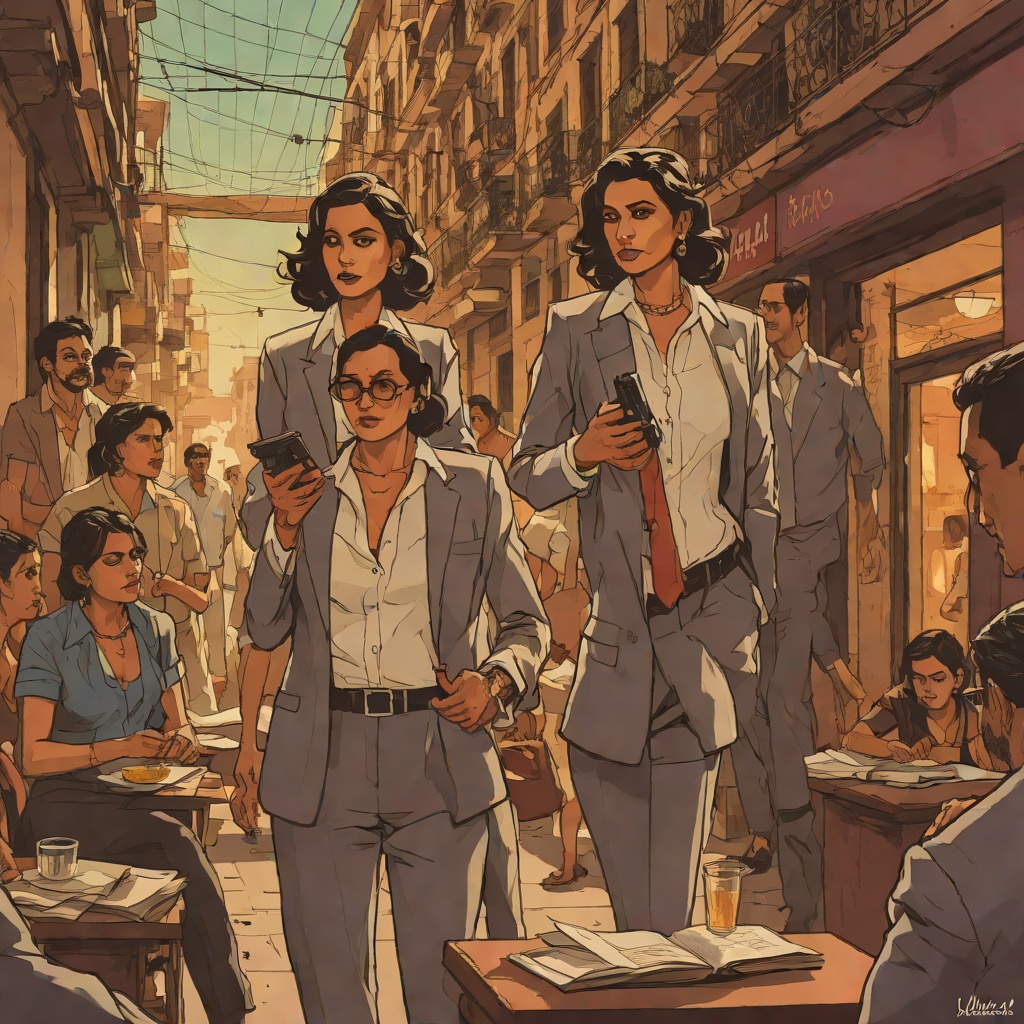
Mafia queen
Mafia Queens of MumbaiThe Mafia queen is the defining concept of S. Hussain Zaidi's Mafia Queens of Mumbai, a term that gathers thirteen disparate women—bootleggers, brothel madams, drug empresses, mobster's molls, and ganglords' wives—under a single, provocative crown. The phrase is not merely a title but a lens through which the book reimagines the Mumbai underworld, a space typically narrated through its male dons. By naming these women queens, the book asserts that they were not peripheral figures in the city's criminal history but central powers in their own right, figures who commanded respect, fear, and even political influence. The concept is introduced with a challenge, asking readers to decide who among these women truly deserves the title, and it is this question that structures the entire collection of stories.
The Concept as a Challenge to the Underworld's Gender Order
The Mafia queen concept is built on a direct confrontation with the male-dominated world of the Mumbai mafia. The book's foreword, written by filmmaker Vishal Bhardwaj, frames these women as having 'broke through the glass ceiling in the absolute stronghold of brutal masculinity called the Underworld.' This is not a metaphor of gentle ascent but of violent rupture. The author, S. Hussain Zaidi, reinforces this by noting that while it is easy to find 'clones galore' of the male dons like the Chhotas (Rajan and Shakeel), it is rare to find a woman like Sapna Didi, who dared to stand up against Dawood Ibrahim and was killed for it. The concept, therefore, is not about celebrating crime but about recognizing the extraordinary agency of women who operated in a sphere where their very existence was a transgression. The book's structure, with chapters titled 'The Wily Old Woman of Dongri,' 'The Matriarch of Kamathipura,' 'Femme Fatale,' 'The Narco Empress,' and 'Mobster's Moll,' uses the queen archetype to give each woman a distinct, powerful identity, transforming them from anonymous criminals into memorable figures of legend.
The Queen as an Economic and Political Power
The Mafia queen concept is grounded in the women's concrete economic and political achievements, which the book documents in detail. Jenabai Daaruwali, the 'Wily Old Woman of Dongri,' built her power by brokering smuggled grain in the 1940s, playing intermediary between wholesalers at Daana Bazaar and dealers, a trade that made her a local power despite police raids. Mahalaxmi Papamani, the 'Narco Empress,' transformed the Sion-Koliwada slum into a drug den, buying heroin in bulk and converting it into small pudis for sale, a business that earned her a CEO's salary and forced her to stock liquid cash across the slum. Sujata Nikhalje, wife of Chhota Rajan, used her reputation as 'Nani' to arm-twist people into selling their homes, then launched her own construction company, Khushi Developers Private Ltd, signing deals worth crores of rupees. These are not stories of petty crime but of empire-building, where the women's shrewdness, business acumen, and willingness to use fear made them formidable players in Mumbai's economy. The concept of the queen, therefore, is tied to their ability to accumulate wealth and power in a world that denied them both.
The Queen as a Political and Social Force
The Mafia queen concept also extends into the political and social arena, where these women wielded influence that rivaled that of male politicians. Gangubai Kathiawadi, the 'Matriarch of Kamathipura,' is the clearest example. She successfully spearheaded a movement against the evacuation of sex workers from Kamathipura, and her political connections won her an appointment with Prime Minister Jawaharlal Nehru, making her the only local brothel madam to secure such a meeting. Her famous speech at Azad Maidan, where she declared, 'I am a gharwali (a brothel madam) not a ghar todnewali (home wrecker),' was a bold public defense of her profession, framing sex workers as protectors of society's morality. Asha Gawli, wife of Arun Gawli, similarly became a political force, heading the women's wing of his Akhil Bharatiya Sena and using it as a shield to protect her husband from arrest. She filed his nomination papers, campaigned for him, and even worked in his constituency to redress grievances, effectively running his political career from behind the scenes. These women were not just criminals; they were political actors who understood the levers of power and used them to protect their interests and those of their communities.
The Queen as a Media and Cultural Phenomenon
The Mafia queen concept is also a media and cultural phenomenon, as the book itself is a product of and a contributor to the women's fame. The book's title and structure turn these women into celebrities of a sort, their stories adapted into films and their lives scrutinized by the press. Monica Bedi, a 'Bewitching Beauty,' became a national spectacle when she appeared on the reality show Bigg Boss 2, using the platform to plead for public sympathy and a chance to rebuild her life. Tarannum Khan, a bar dancer caught in a cricket betting scandal, became a figure of public fascination, her story inspiring a low-budget film titled Deepa ki Tarannum. The book's own existence, with its dramatic retellings and its framing of these women as 'queens,' is a testament to their cultural impact. The concept, therefore, is not just a historical label but a living one, continually produced and consumed by the media, the film industry, and the public imagination. The book's final question, 'Mumbai ki queen kaun?', is an invitation to the reader to participate in this cultural production, to choose their own queen from the pantheon of women presented.
The Concept's Ambiguity and Moral Complexity
The Mafia queen concept is deliberately ambiguous, refusing to offer a simple moral judgment. The author states that the book is 'an attempt to understand the complex minds and the psyche of women criminals' and that it is 'in no way meant to glorify them.' The women are presented as neither pure victims nor pure villains but as complex figures who 'pushed the boundaries of our dominant moral codes.' Gangubai, for instance, is remembered for her goodness—adopting orphans and ensuring their education—but also for her dark side, as a former restaurateur notes, 'It is not like she was all milk and honey. We mustn't forget that she was running a brothel at the end of the day.' This ambiguity is central to the concept. The Mafia queen is not a simple archetype of female empowerment or a cautionary tale of criminality; she is a figure who embodies both the possibilities and the costs of transgression. The book's refusal to judge, its insistence on presenting facts and letting readers draw their own conclusions, is what makes the concept so powerful and so enduring. The queens are not blank slates written upon by dangerous male mafia members; they are active agents whose stories challenge easy categorization and force a reckoning with the complex realities of crime, gender, and power in Mumbai.